A Collection of Vintage Iron

The Forty‑Fives

Ten 45 lb Olympic plates, gathered one at a time. Each one cast decades ago, each one still doing its job.

Sort by
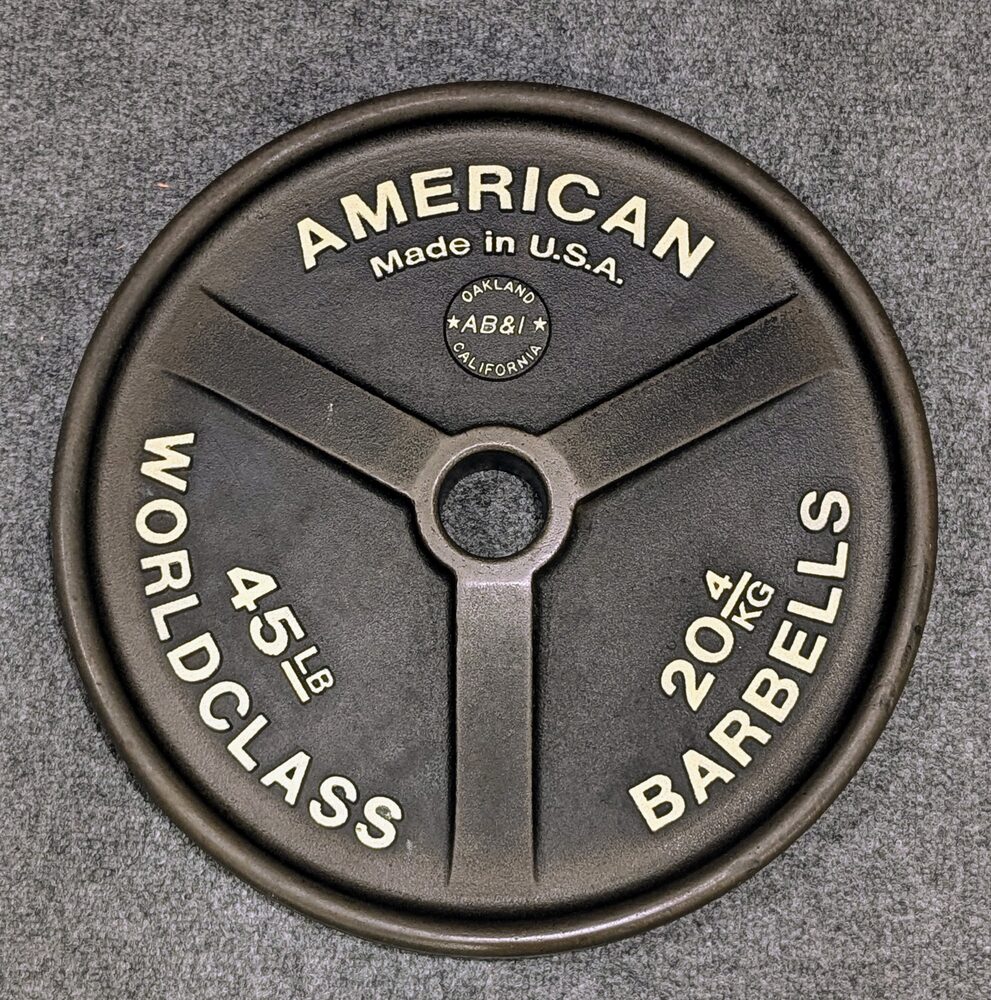
01 American World Class Barbells 45 lb plate, black with raised white lettering and AB&I Oakland foundry mark

American World Class Barbells

45 lb · 20.4 kg 1980s Iron Guide Rating: D, 14

American Worldclass weight plates were manufactured in the 1980s by the AB&I Foundry (American Brass & Iron) in Oakland, California. American Worldclass was not a separate incorporated company but rather a short-lived product line cast directly by AB&I, a foundry better known for iron plumbing parts. Production likely began in the early 1980s and ended by the early 1990s. Vintage equipment collectors suggest the line was discontinued due to increasing environmental regulations; AB&I was identified as one of the largest emitters of hazardous pollutants in the Bay Area during that period.
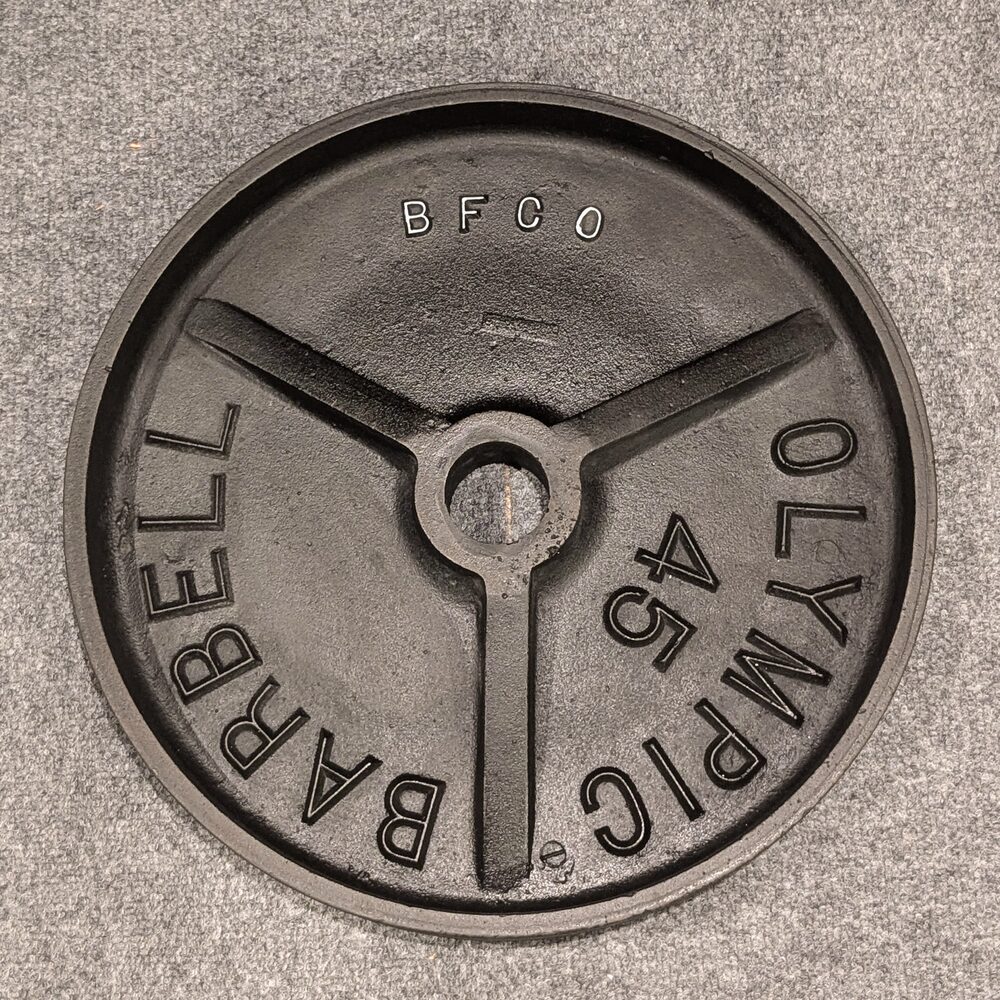
02 BFCO Olympic Barbell 45 lb plate, plain cast iron with recessed lettering

BFCO

45 lb 1960s Iron Guide Rating: B, 28

BFCO is the foundry mark of the Bell Foundry Company, an iron works founded in 1923 that operated from the same South Gate site in greater Los Angeles from 1927 until it closed in 2022. Barbell plates were never the business — Bell poured them as fill-in work to keep the furnaces busy between industrial casting jobs, and cast for a string of West Coast private labels who saved on freight by having their iron made locally, which is why a mid-century Southern California gym floor was typically a mix of BFCO- and Paramount-marked plates. The identification comes from iron-game writer Dr. Ken Leistner, who was driving a Nautilus delivery truck in 1974 when he discovered at the LA Rams facility that the ubiquitous BFCO plates were Bell’s — and who described the plate casting he witnessed as “perhaps the hottest and dirtiest of labor I had seen in many years.” When environmental regulations shuttered most American foundries in the mid‑1970s, Bell kept pouring, and its unpainted plates were hauled cross-country to gym owners — which is why LA’s house plate turns up everywhere.

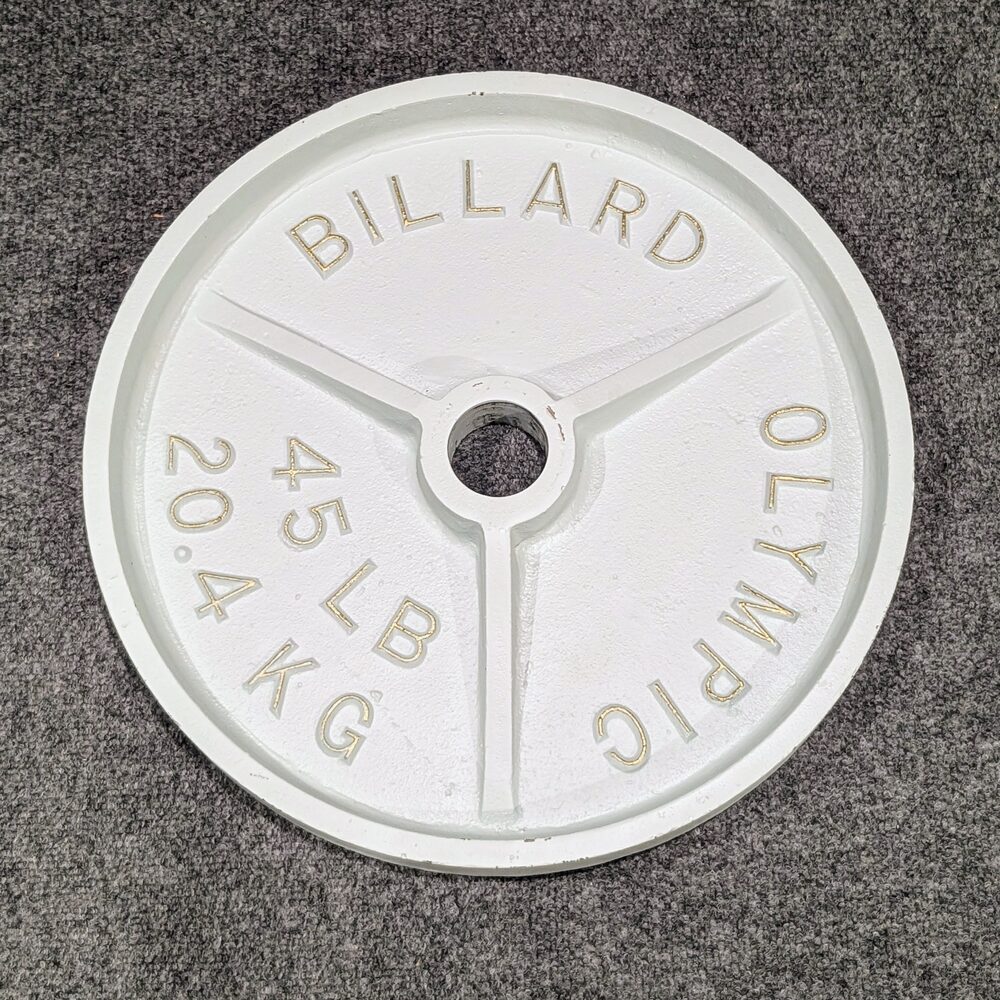
03 White-painted Billard Olympic 45 lb plate with engraved lettering

Billard

45 lb · 20.4 kg 1970s Iron Guide Rating: D, 12

Billard Barbell was the third barbell company to come out of Reading, Pennsylvania — after the Good Barbell Company and the Reading Barbell Company — and sold value-priced sets through department stores from the early 1960s until the early 1990s, with 1959 Mr. Universe Bruce Randall demonstrating them at Sears and Montgomery Ward stores across the country. The “York-Billard Barbell” of vintage lore was never a merger: the two Pennsylvania rivals simply sponsored the same champion Reading fastpitch softball team, whose jerseys read “York-Billard” in 1977–78. Insider accounts suggest the Reading Barbell Company actually cast at least some of Billard’s product, and the plates carry a telltale fluted edge found on no other brand. Billard never shipped a white plate — the factory finish was plain black iron, so this one’s pale coat is an aftermarket repaint.

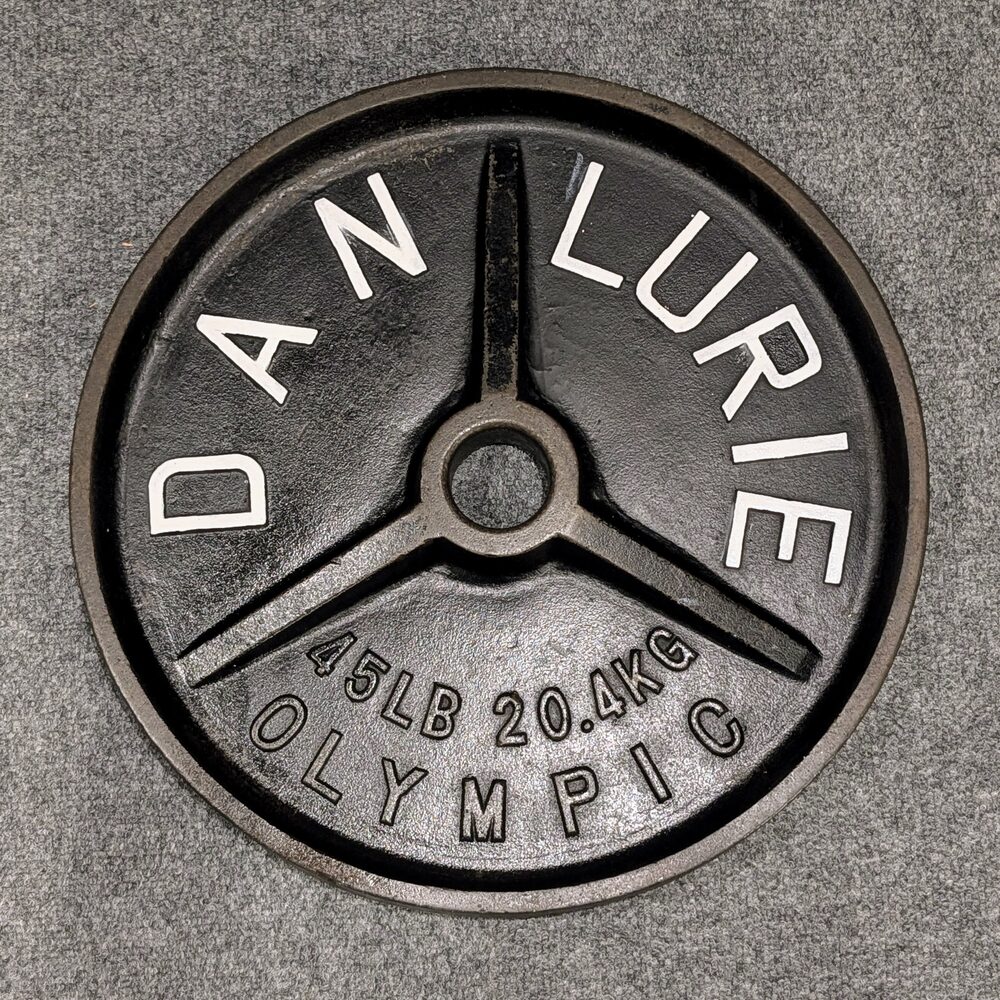
04 Dan Lurie Olympic 45 lb plate with large white block lettering

Dan Lurie

45 lb · 20.4 kg 1980s Iron Guide Rating: C, 22

Dan Lurie was born in Brooklyn in 1923 with a heart murmur that doctors said would kill him by five; he answered with three straight AAU “Most Muscular” titles and a run as “Sealtest Dan the Muscle Man” on 1950s CBS television. His barbell company began in the family basement around 1942 in partnership with a young Joe Weider — a partnership that collapsed into the iron game’s longest feud, with Lurie once challenging Weider to a physique contest from the cover of his own magazine (Weider didn’t show). The business ran until 1988 and left behind the most charismatic typography in vintage iron — collectors call this exuberant style “Cartoon Letter” lettering — a fitting mark for a man who discovered a sixteen-year-old Lou Ferrigno and arm-wrestled Ronald Reagan across the Oval Office desk. Lurie was packing shipments on the morning of his own wedding when a ten-pound plate fell on his head; “Sure I married you,” he told his wife for the next 66 years, “but I was hit on the head with a barbell plate and I didn’t know what I was doing.”

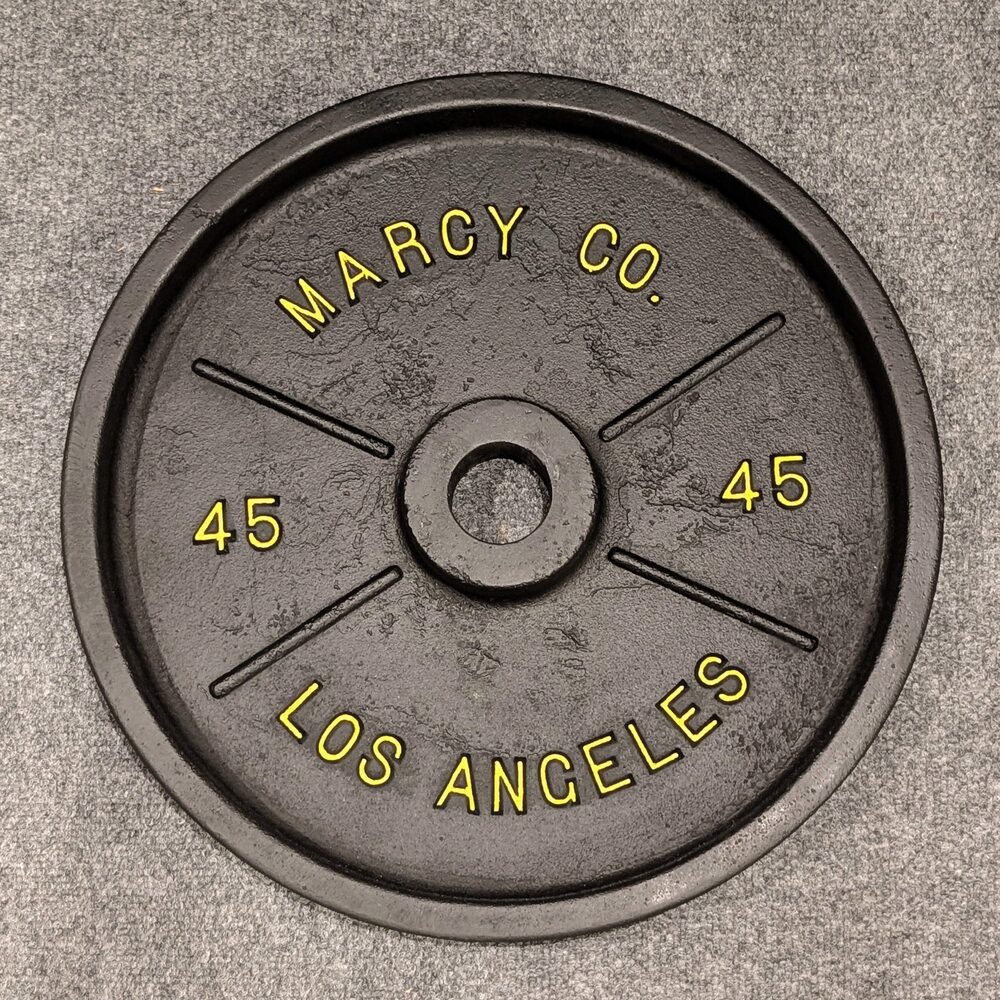
05 Marcy Co. Los Angeles 45 lb plate with yellow lettering and slash-mark web

Marcy Co.

45 lb 1950s Iron Guide Rating: B, 28

Walt Marcyan bought his first barbell at eighteen in Chicago, spent the late 1930s as a vaudeville strongman, and landed at the original Muscle Beach alongside Jack LaLanne and Bill Pearl before opening the first of his seven “House of Health” gyms in Los Angeles in 1946 — with personal trainers, a juice bar, and a sauna, decades ahead of the industry. Dissatisfied with the equipment he could buy, he formalized the Marcy Gymnasium Equipment Company in Glendale in 1959 and went on to build the Circuit Trainer, the multi-station machine that outfitted Bruce Lee’s home gym in Kowloon and, after the 1981 assassination attempt, President Reagan’s rehabilitation gym. The “MARCY LOS ANGELES” deep dish predates all that machinery — The Iron Guide dates it to the 1950s, which makes this the oldest plate in the collection. The radial dashes on the face have a collector’s nickname, “whiskers” — a term that lives in spoken community lore rather than in any book.

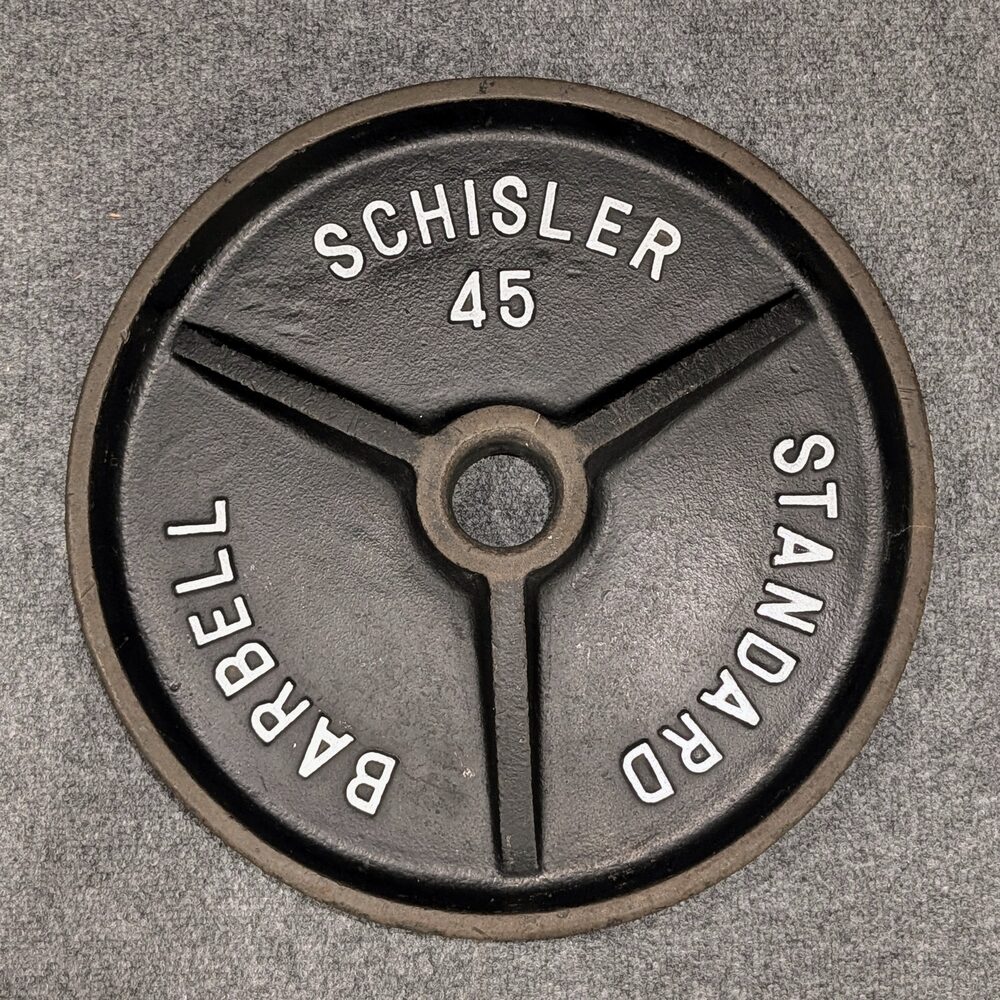
06 Black Schisler Centennial deep-dish 45 lb plate with raised white block lettering

Schisler Centennial Deep Dish

45 lb 1980s Iron Guide Rating: uncataloged

The plainer of the two Schislers, and a plate whose very name is folklore: “Centennial” is a collector nickname coined by Rob of Vintage Weights PGH for this York-style set — no Schisler catalog ever used it, and the company didn’t incorporate until 1983, ruling out any Bicentennial connection. The design copies the visual grammar York had made the American standard — raised outer lip, spoked hub, block lettering around the rim — the kind of legal homage every regional 1980s brand indulged in, rather than shared tooling. Grip athletes have a soft spot for these anyway: the tri-spoke hub makes a fine stand-in for the coveted York deep-dish hub in hub-lifting feats. The company’s story belongs to its flashier sibling, the Eagle Head.

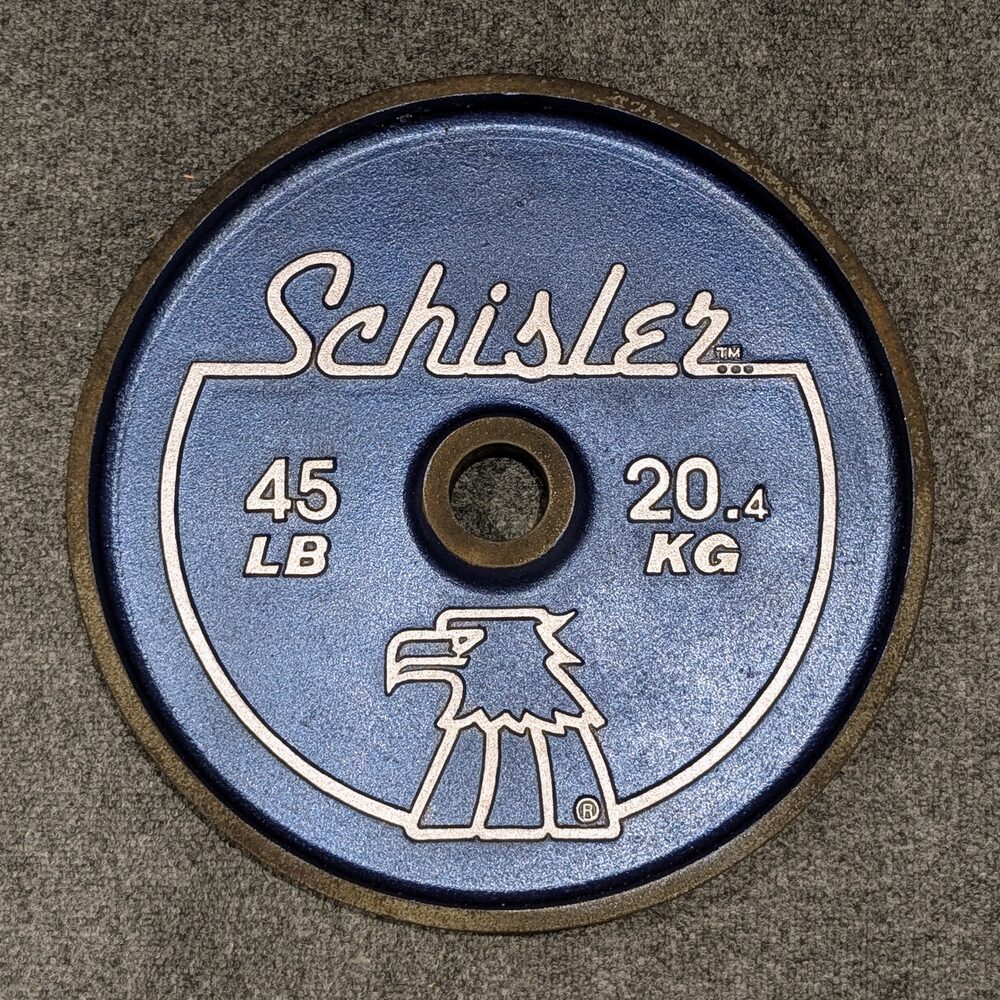
07 Blue Schisler eagle-head 45 lb plate with script logo and eagle graphic

Schisler “Eagle Head”

45 lb · 20.4 kg 1980s Iron Guide Rating: D, 20

Schisler was the plate brand of Buckeye Barbell, Inc., a family business incorporated in Worthington, Ohio in May 1983 — run by the Schisler brothers, later renamed Schisler International, and finally cancelled by the Ohio tax department in 1998. Collector lore holds that the company was founded by four nationally ranked powerlifters, but the corporate paper trail says family enterprise; treat the powerlifters as folklore. The eagle-head deep dish is the brand’s calling card — script logo, shield border, and a registered-trademark bald eagle — and the irony collectors savor is that despite the American eagle, the plates weren’t made in the USA. Schisler shipped these in several factory colorways, blue among them, but this one’s finish is my own: a hand repaint in silver and sparkling blue.

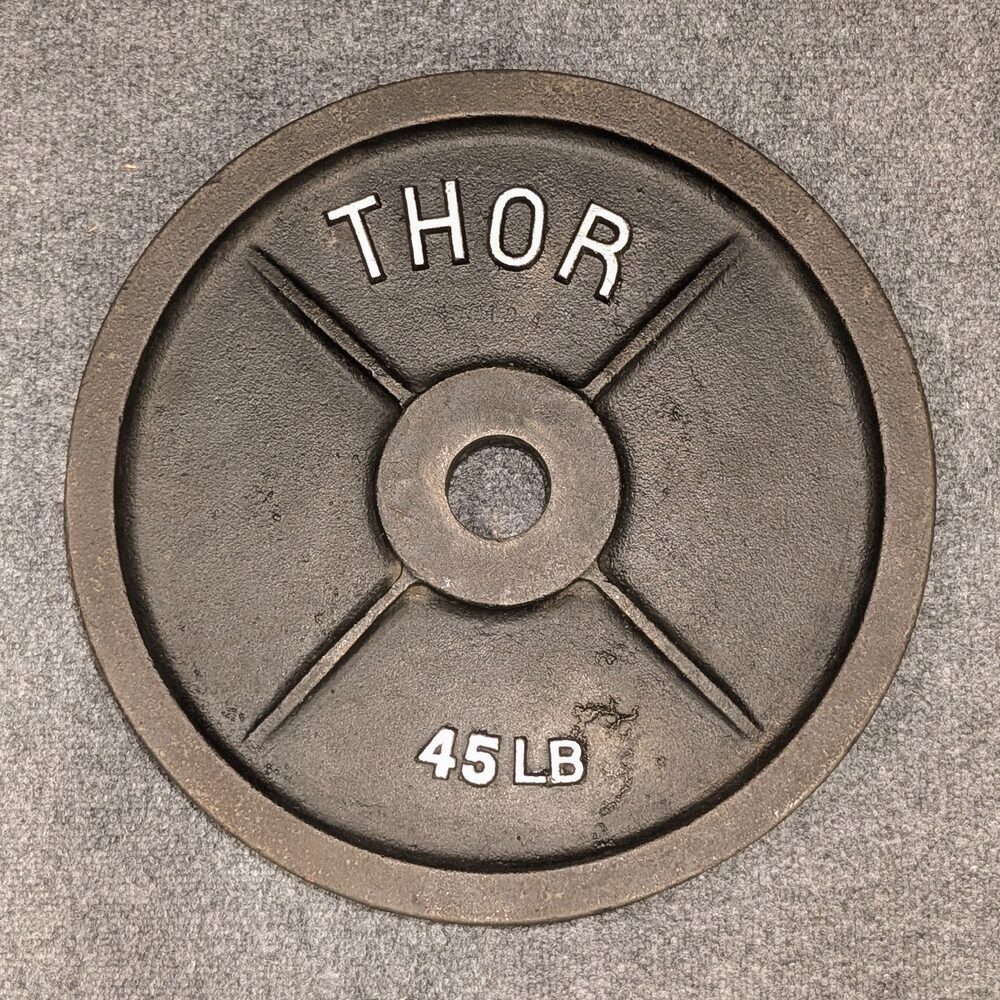
08 Thor 45 lb plate, wide flat rim with white lettering

Thor

45 lb 1980s Iron Guide Rating: C, 20

Thor plates are wonky in the most charming of ways. Their lettering seems to trail downward as if the designer left for lunch break while making the mold and are rife with casting flaws. Why the love? Because they’re rarer, they have a recognizable name people adore because of Marvel, and some believe they were produced on the sly. Supposedly, York USA didn’t know York Canada were making the Thor plates and weren’t happy when they found out.

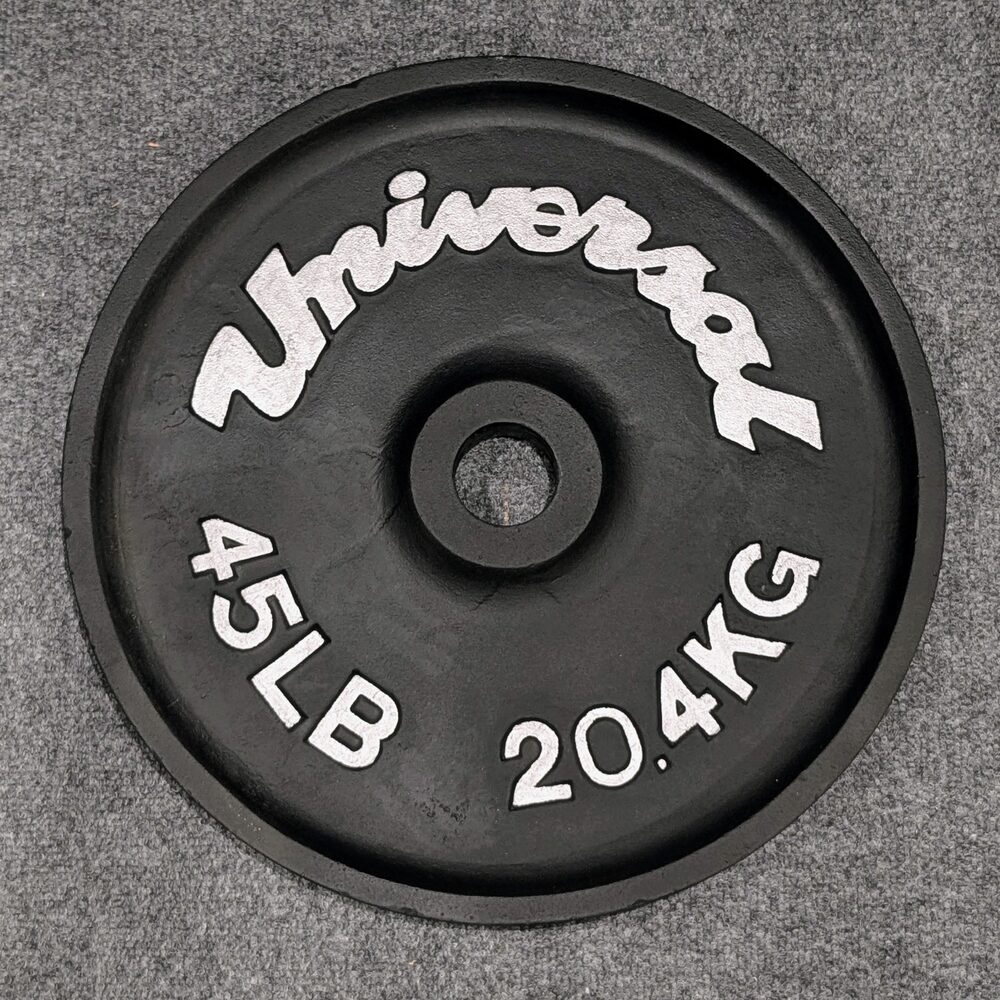
09 Universal script-logo 45 lb deep-dish plate

Universal

45 lb · 20.4 kg 1970s Iron Guide Rating: D, 16

Harold Zinkin was a fixture of the original Muscle Beach — part of the same circle as Jack LaLanne and Joe Gold — the first Mr. California in 1941, and a Navy physical therapist during the war. Convinced that free weights were slow to adjust and easy for a novice to get hurt on, he designed a multi-station machine with pin-selected weight stacks and founded Universal Gym Equipment in Fresno in 1957 to build it. By the 1970s the Universal machine was in practically every school, YMCA, and military base in America — one bodybuilding historian credited Zinkin with doing “more for the acceptance of weight training by college athletes than anyone” — and plates like this one were only ever a side line, cast in a West Coast lineage that shares mold DNA with Paramount. Zinkin sold the company in 1968 but stayed on as CEO for another decade; Universal lost the machine wars to Nautilus in the 1980s and was gone by 1996.

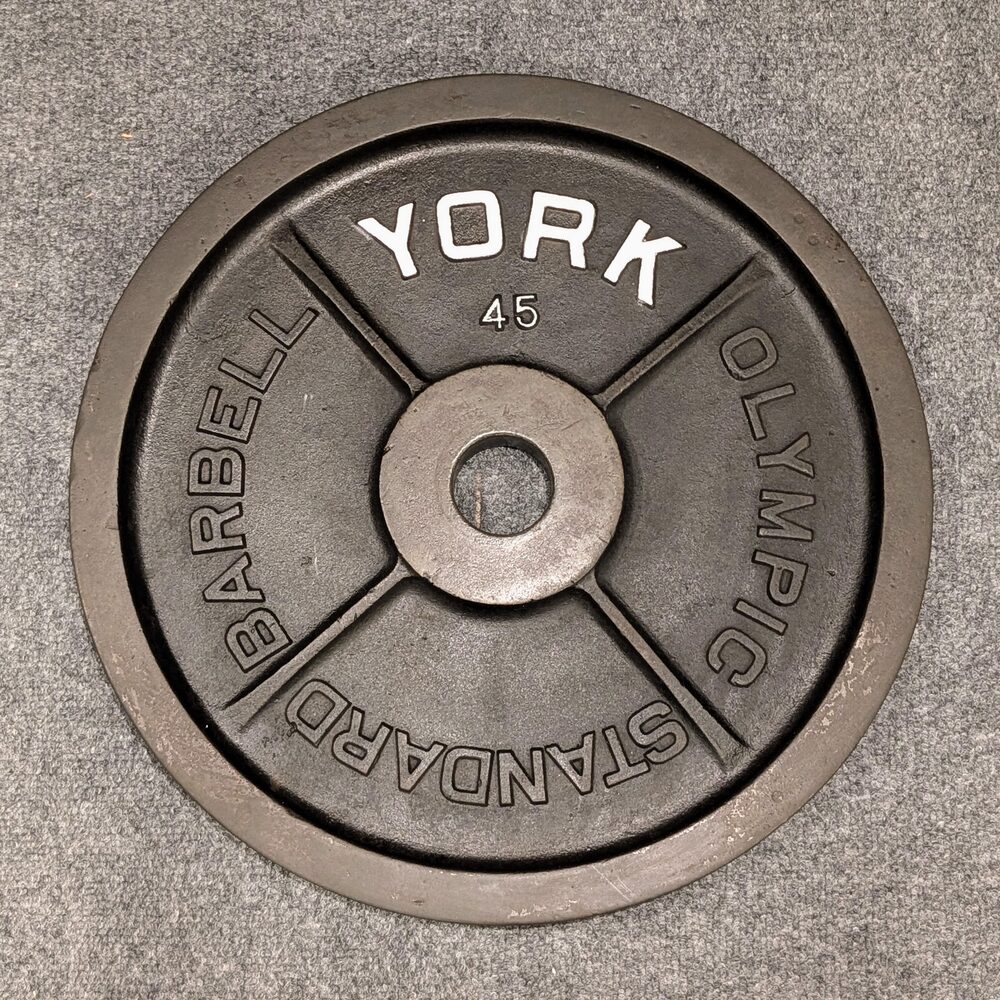
10 York Barbell Olympic Standard 45 lb plate with white YORK lettering and raised center hub

York

45 lb 1970s Iron Guide Rating: D, 14

Bob Hoffman was a decorated WWI veteran making oil burners in York, Pennsylvania when he discovered competitive lifting; by 1929 he was casting barbells in the same factory, and he went on to turn the town into “Muscletown USA” — home of the York Barbell Club, which won 49 national championships and staffed the U.S. Olympic teams Hoffman coached, and of a giant revolving barbell-man statue that still turns over I‑83. York became one of only three companies in the world certified to cast weights for the Olympic Games. What collectors prize from this era is the back of the plate, not the face: from the 1960s into the ’80s a York craftsman laid each casting on a weighing table and hand-milled iron off until it hit true weight, leaving swirling tool marks — real accuracy in an era when rival castings missed by pounds. The missing “USA” stamp is the five-second dating tell: no stamp means the pre-1990s milled era, the plate collectors call “the US dollar of vintage plates — everything else gets priced off it.”